Google shook up the SEO world by announcing big changes to how publishers should mark nofollow links. The changes — while beneficial to help Google understand the web — nonetheless caused confusion and raised a number of questions. We’ve got the answers to many of your questions here.
14 years after its introduction, Google today announced significant changes to how they treat the “nofollow” link attribute. The big points:
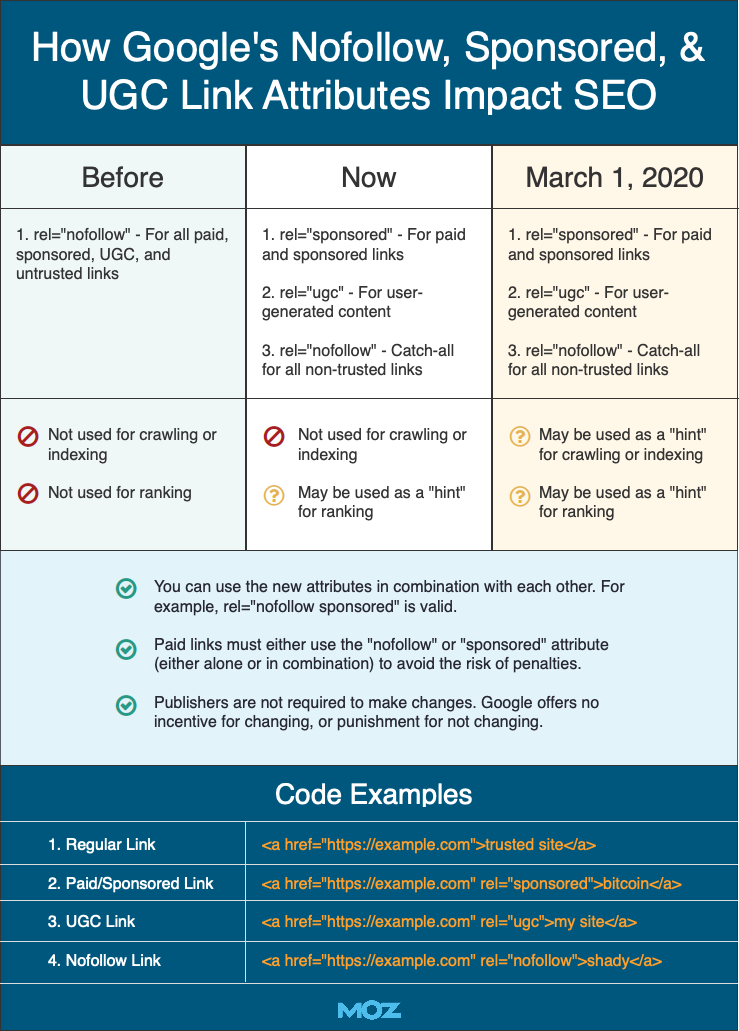
- Link attribution can be done in three ways: “nofollow”, “sponsored”, and “ugc” — each signifying a different meaning. (The fourth way, default, means no value attributed)
- For ranking purposes, Google now treats each of the nofollow attributes as “hints” — meaning they likely won’t impact ranking, but Google may choose to ignore the directive and use nofollow links for rankings.
- Google continues to ignore nofollow links for crawling and indexing purposes, but this strict behavior changes March 1, 2020, at which point Google begins treating nofollow attributes as “hints”, meaning they may choose to crawl them.
- You can use the new attributes in combination with each other. For example, rel=”nofollow sponsored ugc” is valid.
- Paid links must either use the nofollow or sponsored attribute (either alone or in combination.) Simply using “ugc” on paid links could presumably lead to a penalty.
- Publishers don’t have to do anything. Google offers no incentive for changing, or punishment for not changing.
- Publishers using nofollow to control crawling may need to reconsider their strategy.
Why did Google change nofollow?Google wants to take back the link graph.Google introduced the nofollow attribute in 2005 as a way for publishers to address comment spam and shady links from user-generated content (UGC). Linking to spam or low-quality sites could hurt you, and nofollow offered publishers a way to protect themselves.
Hire the Best SEO Company in New York City USA for search engine optimization services at affordable packages. For more information about Top SEO in New York City visit DigitalOye.
Google also required nofollow for paid or sponsored links. If you were caught accepting anything of value in exchange for linking out without the nofollow attribute, Google could penalize you.
The system generally worked, but huge portions of the web—sites like Forbes and Wikipedia—applied nofollow across their entire site for fear of being penalized, or not being able to properly police UGC.
This made entire portions of the link graph less useful for Google. Should curated links from trusted Wikipedia contributors really not count? Perhaps Google could better understand the web if they changed how they consider nofollow links.
Read More At https://moz.com/blog/nofollow-sponsored-ugc Source Of Blog Content.
 Site Title